
Recognizing Women as Clean Cooking Leaders
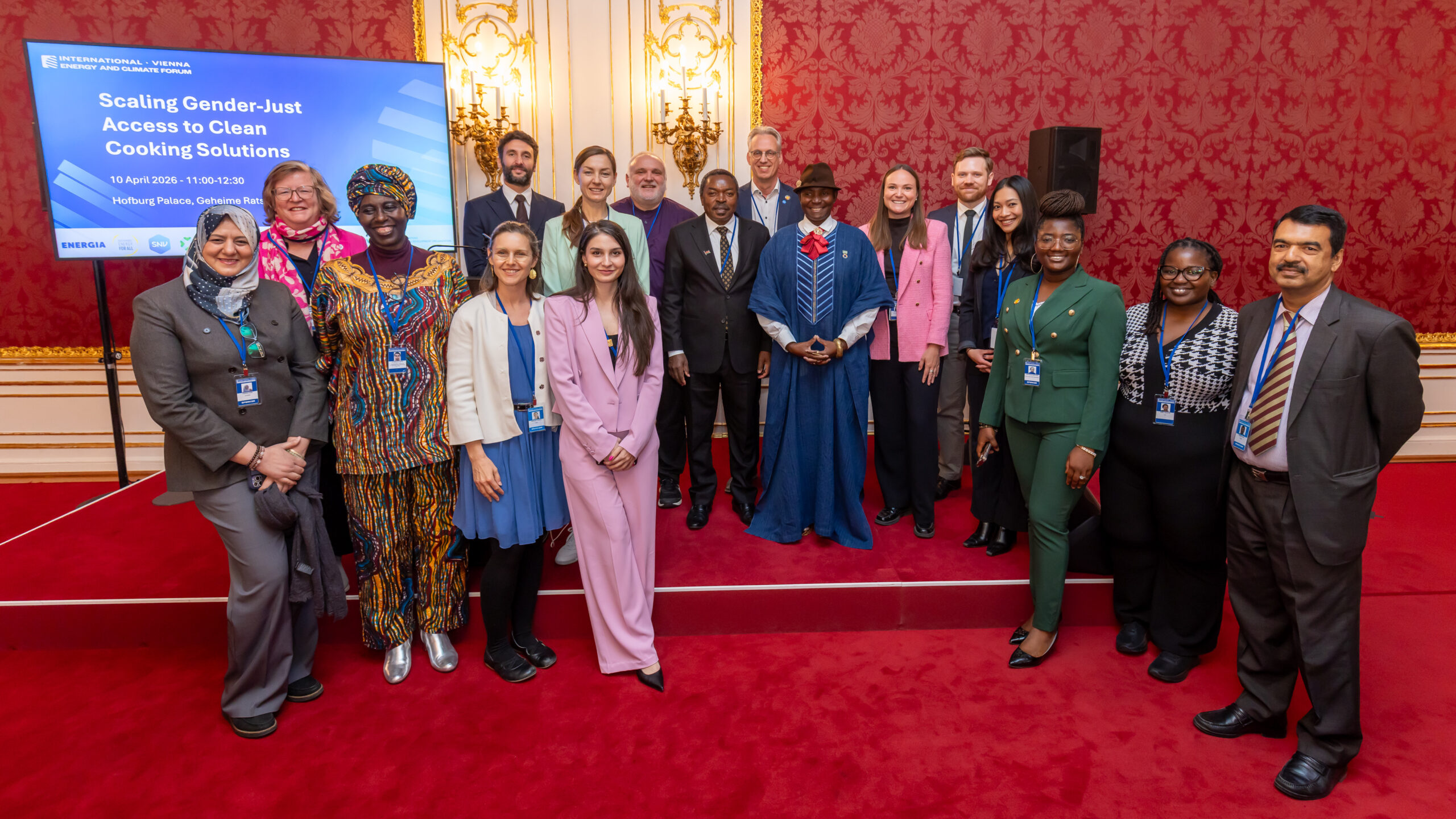
Cooking—perhaps more than any other activity—visibly highlights the global differences in men and women’s access to energy. Addressing this inequality was an important focus of last week’s International Vienna Energy and Climate Forum (IVECF), where the Clean Cooking Alliance (CCA) co-hosted a discussion on gender and clean cooking.
In many countries, women and girls disproportionately bear the impacts of collecting wood and cooking over smoky fires and inefficient stoves—exposing them to air pollution, and costing time and socioeconomic opportunities. Economic forecasts show that women will continue to make up most of the world’s extremely poor, with the gender poverty gap projected to widen by 2030. In displacement settings, these challenges are even more severe, with limited access to safe cooking solutions undermining food security, dignity, and basic needs.
But women are not simply people in need of greater energy access; their experiences, agency, and leadership are fundamental to understanding how clean cooking markets function and scale. Many women are already shaping the clean cooking sector as entrepreneurs, designers, technicians, distributors, and policy advocates.
That’s why the IVECF discussion emphasized an important message: real and lasting energy solutions must center gender equality and invest in the women who are already making a difference. This includes greater representation in decision-making and support in accessing finance, networks, and growth.
The Women in Clean Cooking (WICC) mentorship program—co-organized by CCA, Sustainable Energy for All (SEForALL), and the Global Women’s Network for the Energy Transition (GWNET)—is one initiative trying to do just that. During the IVECF discussion, two entrepreneurs and former WICC participants shared why the clean cooking sector was so meaningful to them, both personally and professionally.
“This is not just an energy issue for me; it is about moving women to cleaner solutions, restoring women’s health, and restoring their dignity,” reflected Jane Ekeh, who is the Co-Founder and Chief Operating Officer of GAS360, a platform that connects clean cooking gas retailers to customers.
Marie-Louise Schmidt, President of the Madagascar Clean Cooking Initiative and General Director of Biogasikara Energy, noted, “For a long time, I was asking myself, what am I doing wrong to face so many challenges? But through this [WICC] program I saw that others face the same realities and it allowed me to learn from others and refine my strategy.”
Their stories underscored a broader insight from the session: by itself, a new cooking appliance does not guarantee consistent adoption and use—that requires trust. Women-led networks are central to creating that trust. Studies show that women entrepreneurs are often very effective in reaching last-mile communities. They understand household dynamics, leverage strong social networks, and invest in the sustained engagement that is required for people to consistently use clean cooking solutions over the long term.
These insights are increasingly reflected in global efforts to integrate gender equality into energy access strategies, such as the Gender and Energy Compact. The compact is a global platform that brings together governments, international organizations, civil society, and the private sector to advance gender equality across energy systems.
To mark its five-year anniversary, at IVECF the compact’s leading organizations launched “Call to Action 2026,” advocating for an urgent, collective effort to place gender equality at the heart of the energy transition. Partners are encouraged to read and endorse the call to action (Learn more).
The discussion on clean cooking and gender at IVECF was joint effort of CCA, ENERGIA, SEforALL, the Global Network of Regional sustainable Energy Centres, the OPEC Fund, GIZ-Endev, and the United Nations Industrial Development Organization.