
47 Million+ (98.2%)
Population without access to clean cooking (Source: WB, 2023)
10+
Active clean cooking ventures (Source: CCA)
7+
Number of clean cooking RBFs (Source: CCA)
Click “Read More” for a detailed overview
Uganda’s clean cooking sector is characterized by a gradual transition from traditional biomass fuels like firewood and charcoal to more efficient, healthier, and environmentally sustainable cooking technologies and fuels. Despite the dominance of biomass, used by about 87% of households, with 73% using firewood and 21% charcoal, there is growing government and international support to scale up clean cooking solutions such as liquefied petroleum gas (LPG), electricity, biogas, ethanol, improved cookstoves, solar cooking, pellets, and briquettes (UNACC).
Adoption of clean cooking technologies remains low, with only about 3.8% of households using clean solutions as of 2024, up from 0.6% in 2023, and roughly 10% of the population adopting clean cooking energy overall (Eni).
The Ugandan government has set ambitious targets to achieve 50% clean cooking access by 2030, aligned with Sustainable Development Goal 7 (SDG 7) for universal access to modern energy.
Uganda’s clean cooking sector is evolving with strong policy support, international funding, and innovative programs. However, overcoming affordability, infrastructure, and cultural barriers remains critical to accelerating adoption and achieving national clean cooking targets by 2030
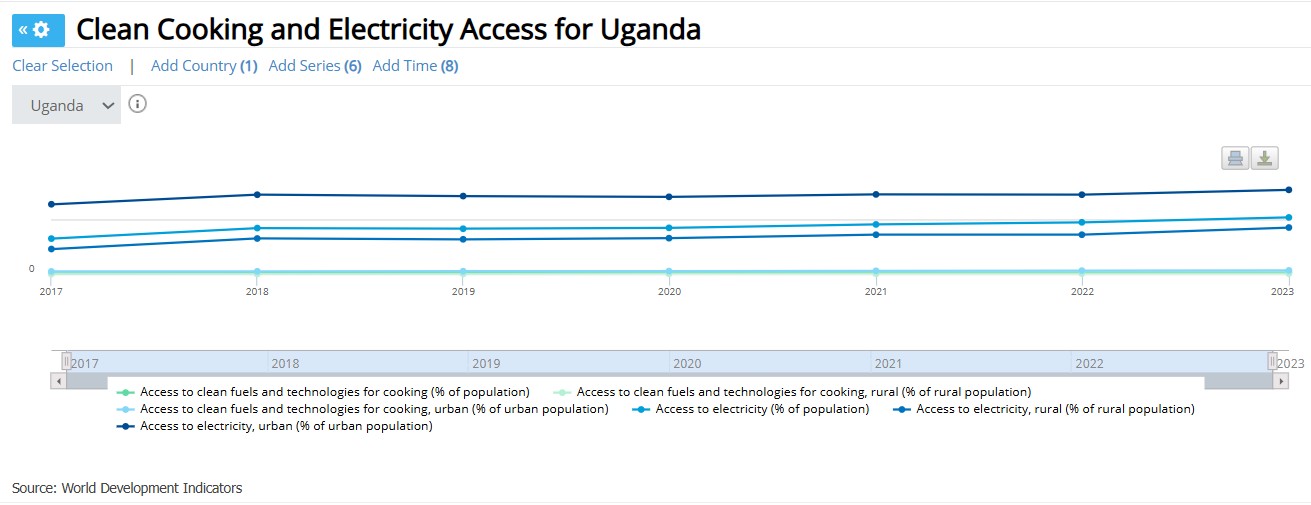
According to World Bank data, 1.8% of the population had access to clean fuels and technologies for cooking in 2023, a drop from the 1.6% who had access in 2022. In 2023, 3.7% of the urban population had access to clean cooking fuels, compared with just 0.8% of the rural population.
Compared with access to clean cooking fuels and technologies, access to electricity in Uganda is relatively higher; 51.5% of the population had access in 2023, up from 47.1% in 2022.
Click ‘Read more’ to explore data from World Bank.
Clean Cooking and Electricity Access for Uganda
Created from: World Development Indicators | DataBank
Click ‘Read more’ to explore relevant aspects of Uganda’s Nationally Determined Contributions and other current policies that are relevant to clean cooking.
Nationally Determined Contributions
Uganda’s Nationally Determined Contribution (NDC) reflects strong commitments to scaling clean cooking as part of its broader climate and development agenda. In its updated 2021 NDC, Uganda commits to an economy-wide emissions reduction target of 24.7% by 2030, with clean cooking interventions projected to contribute approximately 14.75 MtCO₂e in emissions savings. The country aims to increase the proportion of households using clean and efficient cooking technologies to 10% by 2025 and further to 65% by 2030, with electric cooking expected to account for 50% of this target.
These goals are aligned with Uganda’s Third National Development Plan (NDP III) and the 2023 Energy Policy, which seek to reduce reliance on biomass—from the current 88–89%—to about 50% by 2025. To support these commitments, Uganda is developing an Integrated National Clean Cooking Strategy, backed by the Climate and Clean Air Coalition (CCAC) and UNEP. This strategy outlines pathways for transitioning to LPG, electric cooking, ethanol, biomass, and biogas, and includes frameworks for robust monitoring, reporting, and verification (MRV), as well as the development of regulatory standards.
Uganda is also advancing its clean cooking agenda through fiscal incentives such as VAT exemptions and import duty waivers on clean cooking appliances and fuels. At COP28, the government announced plans to raise electric cooking adoption from less than 1% currently to 38% by 2030 and 50% by 2040. These efforts are supported by climate finance mechanisms, including blended finance models and carbon credit-backed initiatives. Despite challenges such as affordability, limited rural electrification, and institutional capacity gaps, Uganda is positioning itself as a regional leader in clean cooking through coordinated policy, financing, and implementation efforts.
| Source | Uganda NDC |
Uganda has 123 registered cookstove projects. These projects have generated 17 million carbon credits to date.
Click ‘Read more’ to explore more.
- Total Credits Issued: 17,048,538
- Total Credits Retired: 12,088,371
- Number of Projects: 122 (114 GS + 9 VCS)
- Number of Project Developers: 32
Source: Voluntary Registry Offsets Database (Berkeley Carbon Trading Project)
Click ‘Read more’ to explore the table of Results Based Finance projects
| Name | Lead | Status | Dates | Applicable Fuels | Fund size for clean cooking | Total fund size |
| HTCC-Higher-Tier Cooking Component | GIZ in Partnership with CLASP | Active | 2023-2025 | Electric, higher-tier biomass | €1.5m (est) | €5m (est) |
| EASP Off-Grid RBF | UECCC(World Bank-funded) | Active | 2024-2027 | Clean cooking, off-grid solar, productive use | $3m+ | $25m+ |
| UECCC RBF Facility | UECCC | Active | Ongoing | Clean cooking | Not specified | Flexible, rolling basis |
| EnDev Uganda RBF | GIZ-EnDev/PSFU | Active | Ongoing | ICS+Solar+refugee energy | N/A | N/A |
| RECF Cooking Window | UNCDF | Completed | 2017-2020 | Briquettes, Ethanol, LPG | $75K-150K | $150K-225K |
| Clean Cooking Supply Chain Expansion | SNV/EnDEv | Completed | 2016-2019 | Improved biomass stoves | N/A | N/A |
| ACCES Distribution Challenge Fund | ESMAP/AFTEG | Active | 2015-Ongoing | ICS distribution scale up | $6m | $6m |
Connect With Us
If you’d like to see more data on this page, please email carbon@cleancooking.org or fill in the form below.