
Building a More Customer-Centric M-Gas
A case study from the User Insights Lab
M-Gas is one of a small number of clean cooking operators actively investing in the internal structures and capabilities needed to act on customer insight consistently. Over the past 18 months, working with the Clean Cooking Alliance’s User Insights Lab (UIL), the company has moved from a research-informed understanding of its customers to tangible changes in how it is organized, how it measures performance, and how it engages customers at risk of lapsing.
What is M-Gas?
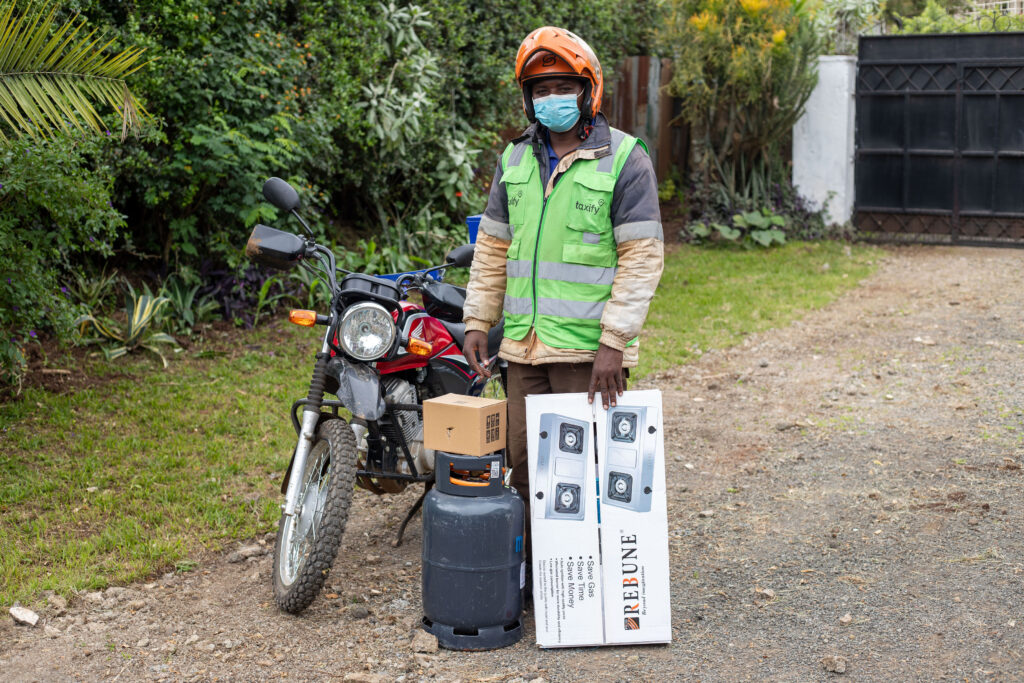
Based in Kenya, M-Gas is a pay-as-you-go fuel system where customers can purchase liquified petroleum gas (LPG) in small, pre-paid amounts using the mobile money application M-PESA. Once a prepaid amount is used up, the gas supply is automatically paused. These exchanges are made possible by a smart meter on every LPG cylinder that tracks gas consumption in real-time. When gas levels run low, the smart meter automatically triggers a message to the company to deliver a new cylinder. Compared with traditional LPG sales that require a large upfront payment for an entire cylinder, M-Gas’ approach makes clean-burning LPG more accessible to low-income households whose income streams may be variable and unpredictable.
How M-Gas was identified
The UIL conducted primary research across the clean cooking sector in Kenya, identifying which companies had both the potential and the appetite for customer experience transformation. M-Gas stood out. The company already used technology to remotely monitor customers’ fuel consumption and maintained significant control over multiple stages of the customer journey. Its leadership had signaled a genuine commitment to improving how customers were served. M-Gas was the right company to work with.
Starting with the customer
The work began in mid-2024 with a structured research phase designed to surface what M-Gas customers actually prioritize and how well the company was delivering against those priorities. Qualitative interviews and focus groups identified three broad themes: affordability and accessibility; safety and reliability; and customer service and support.
These themes shaped a quantitative diagnostic. The UIL worked with M-Gas to develop 26 customer expectations spanning five stages of the customer journey:
- Understanding and deciding to buy
- Registration and onboarding
- Everyday consumption
- Troubleshooting
- Staying informed and feeling valued
Each expectation had surfaced through the qualitative phase and was included in full in the survey. Field agents interviewed a total of 306 M-Gas customers, in person. Each expectation was rated twice: once for how important it was to the customer, on a scale of zero to 10, and once for how well M-Gas was currently delivering against it, on the same scale. Customers also rated M-Gas against competitors on quality and price and provided loyalty and recommendation scores. The result was a detailed picture of where customer priorities were high but delivery was falling short, and that became the basis for everything that followed.
The resulting analysis gave M-Gas a clear basis for deciding where to focus. The company established two cross-functional workstreams: “Fast, Expert Support” and “Cook Clean Whatever Your Wallet.” Each workstream was provided with named ownership, specific objectives, and a regular rhythm of progress meetings to maintain accountability.
What M-Gas built
The diagnostic and blueprints set the direction and have led to four initiatives focused on improving customer outcomes.
Restructuring for customer ownership
M-Gas has begun separating sales and maintenance roles, which were previously combined, to create clearer ownership of ongoing customer support and service delivery. This is a company-wide change and an ongoing process. It is a structural decision that signals a serious shift in how customer responsibility is distributed.
Building a retention capability
A centralized retention function has been introduced on a pilot basis, focused on customers showing signs of low or declining usage. Rather than treating non-usage as a single problem, the team developed a triage approach: distinguishing between situations where M-Gas may be contributing to the barrier, and situations driven by customer circumstances, such as travel or returning to a regular LPG supplier.
Each category triggers a different response: escalation where a company-side issue is identified, or targeted customer messaging where the barrier is circumstantial. One example is helping customers understand they could prepare an evening meal at a daily cost of KES 25, reducing the risk of lapse.
Progress so far: 35% reduction in non-usage among customers engaged by the retention team, over a 25-week period.
Measuring what matters
M-Gas has introduced a Customer Effort Score study using a short, three-question telephone survey administered shortly after service interactions. The questions focus on how many times a customer had to call, how much effort the interaction required, and overall satisfaction.
Progress so far: 10,000 customers reached in the first cycle, Q4 2025, to be repeated quarterly.
The finding was striking: around 40% of customers had called two or more times. Rather than leaving that at a headline, M-Gas cascaded it through the organization and incorporated it into the end-of-2025 appraisal process, enabling performance to be reviewed at the level of individual team members.
Raising the standard at installation
Since November 2025, across the full business, M-Gas has placed greater emphasis on demonstrating the product and explaining usage at the point of installation. The intention is to treat installation as the beginning of the customer relationship rather than a purely technical transaction.
Why this matters for the clean cooking sector
These changes are still being incorporated. Already, they represent something that M-Gas is pioneering in the clean cooking sector: an operator systematically building the internal capability to understand its customers, act on what it learns, and hold itself accountable for the results. Part of what made this change possible was bringing together people from across the business who would not typically collaborate: customer service, operations, product, and commercial teams, working around a shared set of priorities.
What stands out is not any single initiative. Most operators gather customer feedback at some point. Fewer act on it in a structured way, with clear priorities and named owners. Fewer still measure whether the changes they made actually worked. What M-Gas has built, and is still building, is a way of keeping all three connected. The M-Gas experience offers a practical starting point for other operators considering the same approach.
What other operators can do
The approach described here is not dependent on a large budget, a specialist team, or bespoke tools. It is a structured cycle: listen to customers, focus on the right problems, fix them with clear ownership, check whether things improve, and repeat.
COMING SOON: The UIL has developed a self-service toolkit based on the M-Gas experience, designed for clean cooking operators to use with the people and resources they already have. It sets out the same five-step process in a practical workbook format, including the triage approach to declining usage, a simple measurement method, and a one-page accountability template.