
Read CCA's 2025 highlights in its latest annual report

Overview

120 Million+ (92.9%)

Population without access to clean cooking (Source: WB, 2023)

26+

Active clean cooking ventures (Source: CCA)

4+

Number of clean cooking RBFs (Source: CCA)

Click “Read More” for a detailed overview

Ethiopia’s clean cooking sector is undergoing transformative efforts to shift from traditional biomass reliance to higher-tier clean cooking technologies through coordinated government policies, stakeholder collaboration, market development projects, and support for local entrepreneurship.

The clean cooking sector in Ethiopia is characterized by a significant challenge: over 96% of Ethiopian households rely on traditional biomass fuels, mainly firewood (82%), for cooking (Europa). This reliance leads to severe health issues due to indoor air pollution, environmental degradation, and contributes to climate change, while also imposing a heavy burden on women who are primarily responsible for cooking and firewood collection.

The sector is gradually embracing a range of clean cooking solutions, including electric cooking and advanced biomass stoves, though improved biomass cookstoves still receive considerable emphasis. Ethiopia has ambitious targets to increase clean cooking access to 33% by 2030 and modern energy cooking access to 21% by 2030, aligned with its Nationally Determined Contribution (NDC) to climate change mitigation (NDC Partnership).

Read MoreLess
Supply
Demand

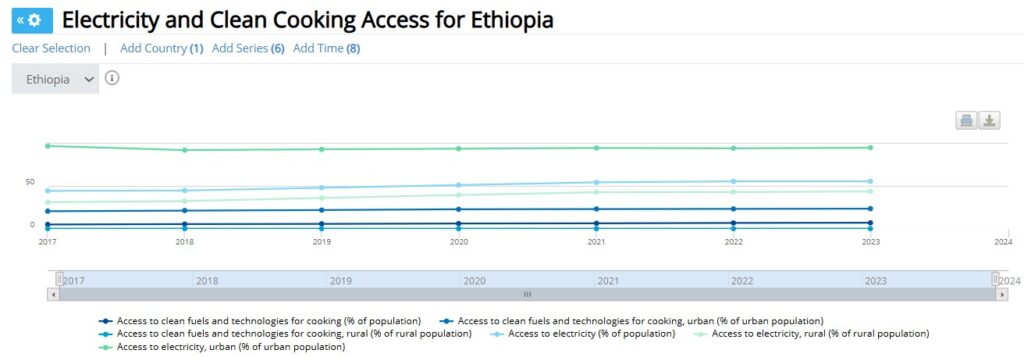
According to World Bank data, 7.1% of the population had access to clean fuels and technologies for cooking in 2023, a slight improvement over the 6.9% who had access in 2022. In 2023, 23.6% of the urban population had access to clean cooking fuels, compared with just 0.3% of the rural population.

There is better access to electricity in Ethiopia: 55.4% of the population had access in 2023, same as the previous year (2022), and slightly above 2021 (54.2%). There is a significantly wide gap between urban and rural population access to electricity (94.7% and 43.6% respectively) and access to clean fuels and technologies for cooking. This calls for a special attention and need for interventions.
Read MoreLess
Policy

Click ‘Read more’ to explore relevant aspects of Ethiopia’s Nationally Determined Contribution and other current policies that are relevant to clean cooking.

Nationally Determined Contributions

Ethiopia’s Nationally Determined Contribution (NDC) explicitly recognizes clean cooking as a critical component of the country’s climate mitigation and sustainable development strategy. The updated NDC sets ambitious targets to increase clean cooking access and reduces emissions from traditional biomass cooking, which is a major source of deforestation, indoor air pollution, and black carbon emissions.

Ethiopia aims to increase clean cooking access to 33% by 2030, including through improved biomass cookstoves and modern energy cooking solutions such as electric cooking and LPG. Transitioning households from traditional biomass fuels (firewood, crop residues, dung) to clean cooking technologies is expected to substantially reduce greenhouse gas emissions, particularly CO₂ and black carbon, a potent short-lived climate pollutant. The NDC emphasizes the promotion of electric cooking alongside improved biomass stoves, supported by Ethiopia’s expanding electricity access and renewable energy development plans. The goal is to reach 21% modern energy cooking access by 2030.

Ethiopia’s NDC highlights the need for coordinated efforts among government ministries, development partners, private sector, and civil society to develop a comprehensive roadmap, investment plan, and value chain analysis for scaling clean cooking solutions sustainably. Initiatives like UNDP’s Climate Promise and collaborations with GIZ, SNV, and the World Bank support Ethiopia’s NDC implementation by enhancing institutional capacity, facilitating financing, and promoting clean cooking technologies.

Source Ethiopia’s NDC-2021
Read MoreLess
Carbon

Ethiopia has 32 registered cookstove projects. These projects have generated 0.9 million carbon credits to date.

Click ‘Read more’ to explore more

  • Total Credits Issued: 863,783
  • Total Credits Retired: 9,158,813
  • Number of Projects: 32 (30 GS + 2VCS)
  • Number of Project Developers: 14

Source: Voluntary Registry Offsets Database (Berkeley Carbon Trading Project)

Read MoreLess
Results Based Finance
Name Lead Status Dates Applicable Fuels Fund size for clean cooking Total fund size
EnDEv/DFID RBF for Biomass Stoves EnDev/DFID Completed 2013-2017 Biomass €1.4M €3M
WB Clean Cooking RBA/RBF Pilot MoWE/World Bank Completed 2019-2022 Biomass, Electric, LPG $5M $30M(planned scale)
SNV HTCC RBF Pilot SNV/EU-GIZ-RVO Active 2023-2025 Pellet, Electric, Biomass €2M €2-3M
SNV/GIZ Market Enhancement RBF SNV/GIZ EnDev Active 2024-2026(est) Electric, Pellet, Ethanol €4-6M €6-8M
Read MoreLess

Connect With Us

If you’d like to see more data on this page, please email carbon@cleancooking.org or fill in the form below.