
Read CCA's 2025 highlights in its latest annual report

Overview

12Million+ (90.7%)

Population without access to clean cooking (Source: WB, 2023)

21+

Active clean cooking ventures (Source: CCA)

1+

Number of clean cooking RBFs (Source: CCA)

Click “Read More” for a detailed overview

The clean cooking industry in Rwanda is characterized by significant reliance on biomass, with about 93% of households still depending on firewood and charcoal as of 2022(Mecs). This dependency contributes to deforestation, household air pollution, and health issues.

The government aims to provide clean cooking solutions to at least 500,000 households, benefiting around 2.15 million people by 2026, with an emphasis on supporting female-headed households (world bank). Common clean cooking solutions in Rwanda include improved cookstoves, which reduce biomass use and emissions by up to 50%, and are widely distributed through subsidies. The government is promoting the adoption of Liquefied Petroleum Gas (LPG) as a central transition strategy. Additionally, biogas technologies are encouraged, particularly for rural and peri-urban settings, while electric cooking, though currently used by less than 1% of households, has strong growth potential due to rapid electrification increases. Other alternatives include pellets, briquettes, and solar-powered devices used both domestically and in institutions such as schools and health centers. The government supports the sector through initiatives like the Clean Cooking Results-Based Financing program, which offers subsidies to increase affordability and accessibility, especially for poorer households.

Collaboration with the private sector enhances manufacturing and distribution of clean cooking technologies, alongside regulatory frameworks that introduce product standards, testing, certification, and public awareness campaigns. Strategic policies such as the Rwandan Energy Policy and Biomass Strategy provide clear direction for phasing out charcoal and expanding modern energy access.

Despite these efforts, challenges remain, including affordability, limited awareness, technical skill gaps, and gender disparities. The environmental urgency is underscored by the weekly loss of approximately 380 hectares of forest due to charcoal and firewood use. The transition to clean cooking requires substantial investment, estimated at $1.37 billion by 2030(world bank). Overall, with strong policy backing, growing private sector involvement, and structured financing, Rwanda’s clean cooking industry is poised to significantly reduce biomass dependence, improve public health, and promote environmental sustainability.

Read MoreLess
Supply
Demand

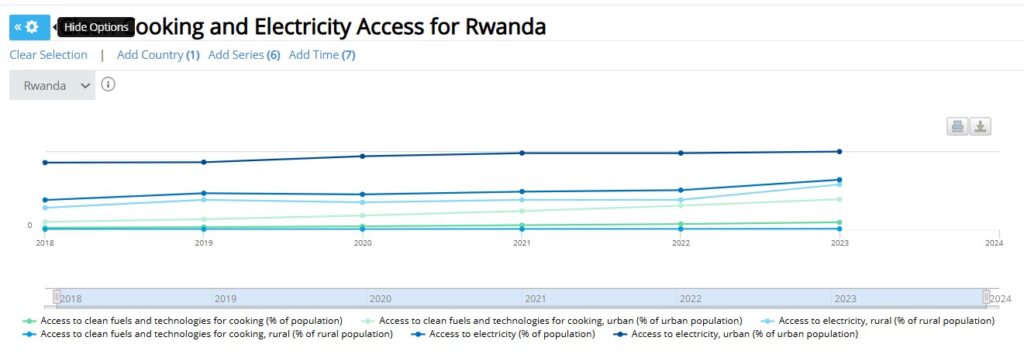
According to World Bank data, 9.3% of the population had access to clean fuels and technologies for cooking in 2023, an improvement over the 7.3% who had access in 2022. In 2022, 38.9% of the urban population had access to clean cooking fuels, compared with just 1% of the rural population.

Compared with access to clean cooking fuels and technologies, there is better access to electricity in Rwanda; 63.9% of the population had access in 2023, up from 50.6% in 2022.

While Rwanda has made progress in expanding access to clean cooking solutions, significant gaps remain, especially between urban and rural areas. However, the country’s growing access to electricity presents a promising opportunity to accelerate the adoption of electric cooking technologies, supporting a broader transition to cleaner, healthier, and more sustainable energy use.
Read MoreLess
Policy

Click ‘Read more’ to explore relevant aspects of Rwanda’s Nationally Determined Contributions and other current policies that are relevant to clean cooking.

Nationally Determined Contributions

Rwanda’s Nationally Determined Contributions (NDCs) under the Paris Agreement highlight clean cooking as a critical component of its climate mitigation and sustainable development strategy. The country has committed to reducing its greenhouse gas emissions by 38% by 2030 compared to business-as-usual projections, with clean cooking interventions forming a significant part of the energy sector mitigation efforts. Through its Biomass Energy Strategy 2019–2030, Rwanda aims to drastically reduce reliance on traditional biomass fuels by promoting the adoption of cleaner alternatives such as LPG, biogas, electric cooking, pellets, briquettes, and improved biomass cookstoves.

One of the country’s central clean cooking goals is to reduce the percentage of households relying on firewood for cooking from 79.9% in 2017 to 42% by 2024. In urban and peri-urban areas, LPG is prioritized, with a target of reaching 40% of households by 2024. To support these ambitions, the government has launched the Clean Cooking Results-Based Financing (CC‑RBF) initiative under the broader Energy Access and Quality Improvement Project (EAQIP). This initiative is designed to subsidize the cost of clean cooking technologies and expand access to 500,000 households by 2026, benefiting approximately 2.15 million people, with a focus on supporting women-led households.

Additionally, Rwanda reiterated its clean cooking commitments at COP26 through the launch of an Energy Compact in partnership with Sustainable Energy for All (SEforALL). This compact aligns clean cooking goals with the broader national vision of achieving net-zero emissions by 2050. Clean cooking is also recognized as essential to improving public health, reducing deforestation, and enhancing household energy security, given that inefficient cooking practices contribute significantly to the country’s energy-related emissions. In summary, Rwanda’s NDCs present a bold, integrated approach to expanding access to modern cooking solutions, addressing climate change, and advancing gender and energy equity.

Source Rwanda NDCs
Read MoreLess
Carbon

Rwanda has 92 cookstove projects registered in it. These projects have generated 7 million carbon credits to date.

Click ‘Read more’ to explore more.

  • Total Credits Issued: 7,070,670
  • Total Credits Retired: 1,627,912
  • Number of Cookstove Projects: 92 (83 GS + 9 VCS)
  • Number of Project Developers: 18

Source: Voluntary Registry Offsets Database (Berkeley Carbon Trading Project)

Read MoreLess
Results Based Finance
Name Lead Status Dates Applicable Fuels Fund size for clean cooking Total fund size
Clean Cooking RBF EDCL & BRD (Govt of Rwanda)+World Bank Active 2021-Present Biomass, LPG, Ethanol, Electric $17 million $20 million (Includes technical assistance)
Read MoreLess

Connect With Us

If you’d like to see more data on this page, please email carbon@cleancooking.org or fill in the form below.