

60 Million+ (90.2%)
Clean cooking population without access (World Bank, 2023)
25+
Active clean cooking ventures (Source: CCA)
4+
Number of clean cooking RBFs (Source: CCA)
Click “Read More” for a detailed overview
Tanzania’s clean cooking sector is undergoing a significant transformation aimed at addressing health, environmental, and economic challenges associated with traditional cooking methods.
As of recent assessments, a vast majority of Tanzanian households rely on biomass fuels for cooking, with approximately 84.8% of rural households and 17.4% of urban households using firewood(Eni). Annually, around 469,420 hectares of forests are destroyed for firewood and charcoal production(Eni).
To combat this, the Government of Tanzania has launched the National Clean Cooking Strategy (NCCS) 2024-2034, targeting an 80% adoption rate of clean cooking solutions by 2034 (Tanzania Ministry of Energy).
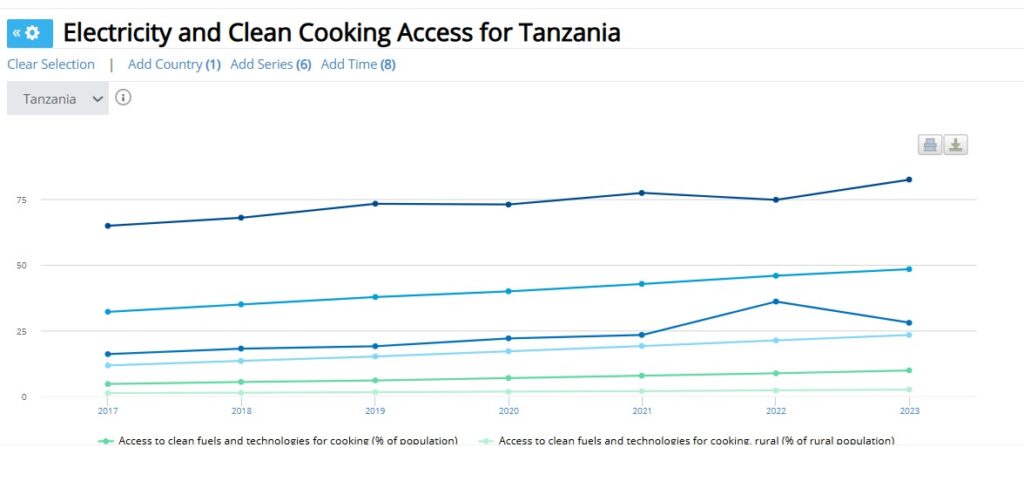
According to World Bank data, 9.8% of the population had access to clean fuels and technologies for cooking in 2023, which rose from 8.7% in 2022. In 2023, 23.3% of the urban population had access to clean cooking fuels, compared with just 2.5% of the rural population.
Access to electricity in Tanzania is relatively higher: 48.3% of the population had access in 2023, up from 45.8% in 2022.
While there has been progress in increasing access to electricity, particularly in urban areas, the adoption of clean cooking fuels and technologies remain low, especially in rural regions. These figures underscore the ongoing challenges and efforts in improving energy access in Tanzania, highlighting the need for continued investment and policy focus, particularly in rural areas
Click ‘Read more’ to explore relevant aspects of Tanzania’s Nationally Determined Contribution and other policies relevant to clean cooking.
Nationally Determined Contributions
Tanzania’s updated Nationally Determined Contribution (NDC), submitted in 2021, places a strong emphasis on clean cooking as a key strategy for both climate change mitigation and sustainable development. The country has committed to reducing its greenhouse gas emissions by 30–35% by 2030 relative to a business-as-usual scenario. A significant portion of this reduction is expected to come from the energy and forestry sectors, where the widespread use of biomass for cooking is a major source of emissions and deforestation. Transitioning to clean cooking technologies is therefore seen as essential to achieving Tanzania’s climate targets.
In the energy sector, the NDC outlines plans to scale up the adoption of clean cooking solutions, including liquefied petroleum gas (LPG), improved biomass stoves, biogas, ethanol, and electric cooking. These technologies offer a pathway to reduce household reliance on woodfuel and charcoal, both of which contribute to indoor air pollution and forest degradation. The NDC further acknowledges that tackling these issues will require supportive policies, public-private partnerships, and accessible financing mechanisms to ensure that clean cooking options are both affordable and widely adopted.
Beyond emissions reduction, clean cooking is positioned in the NDC as a solution with significant co-benefits. From a public health perspective, reducing exposure to household air pollution will lower the incidence of respiratory diseases and premature deaths, particularly among women and children. The transition also has gender and social equity implications, as it relieves women and girls of the time and physical burden associated with collecting firewood—opening up opportunities for education and income generation. In rural communities, improved access to clean cooking enhances resilience by reducing dependence on increasingly scarce biomass resources.
The importance of clean cooking has also been reinforced by the government’s launch of the National Strategy for Clean Cooking Energy (2024–2034), which aims to increase clean cooking access from the current 10% to 80% by 2034. This strategy supports the implementation of the NDC through actions such as fiscal incentives for clean cooking technologies and the enforcement of standards for institutional cooking in schools and hospitals.
However, Tanzania’s ability to realize these clean cooking ambitions is heavily dependent on international support. The NDC highlights the need for financial resources, technology transfer, and capacity building to accelerate progress. In this way, clean cooking is not only a mitigation priority—it is a cross-cutting development strategy that aligns with national goals for health, gender equality, environmental sustainability, and energy access.
| Source | Tanzania NDCs-2021 |
Tanzania has 23 registered cookstove projects. These projects have generated 1.4 million carbon credits to date.
Click ‘Read more’ to explore more.
- Total Credits Issued: 1,446,926
- Total Credits Retired: 285,397
- Number of Projects: 23 (18 GS + 5 VCS)
- Count of Project Developers: 12
Source: Voluntary Registry Offsets Database (Berkeley Carbon Trading Project)
Click ‘Read more’ to explore the table of Results Based Finance projects
| Name | Lead | Status | Dates | Applicable Fuels | Fund size for clean cooking | Total fund size |
| CookFund Programme | United Nations Capital Development Fund (UNCDF) | Completed | 2021-2024 | LPG, Biomass stoves | €1.3m | €17m |
| Rural Energy Agency(REA) Subsidy | Rural Energy Agency (REA) | Active | Improved cookstoves, electric cooking | Not disclosed | $4m | |
| Tanzania Clean Cooking Project (TCCP) | Africa Enterprise Challenge Fund (AECF) | Active | 3 Years | $3.75 | $3.75 | |
| Modern Cooking Facility for Africa | Nefco (Nordic Environment Finance Corporation) | Active | Ethanol, Electric Cooking | €16m | €16m |
Connect With Us
If you’d like to see more data on this page, please email carbon@cleancooking.org or fill in the form below.
