
2.5 Million+ (98.4%)
Population without access to clean cooking (Source: WB, 2023)
10+
Active clean cooking ventures (Source: CCA)
2
Number of clean cooking RBFs (Source: CCA)
Click “Read More” for a detailed overview
The clean cooking sector in The Gambia has seen significant progress in recent years, transitioning from small-scale pilots to large national programs. About 125,000 clean cookstoves are being distributed through initiatives like the Live Well Programme, which is implemented by DelAgua in partnership with the government. These high-efficiency rocket stoves (e.g., Burn stoves from Kenya) reduce wood consumption by up to 70% and significantly lower indoor air pollution (Kenya Ministry of Energy). Earlier pilot projects using improved biomass cookstoves showed promising results, including a 52% reduction in fuelwood use, 40–60% reduction in PM₂.₅ exposure, and 70% less time spent collecting firewood (Kenya Ministry of Energy).
The most common clean cooking solutions in The Gambia include improved biomass cookstoves, rocket stoves, and locally produced clay stoves. These technologies are being promoted by NGOs like CREATE! and Future for Farato, which train women to build and distribute affordable cookstoves using local materials. The Gambian Government, in collaboration with the West Africa Clean Cooking Alliance (WACCA) and the Alliance for Sustainable Cooking Energy in The Gambia (ASCEG), has taken active steps to institutionalize support for clean cooking. These include undertaking national baseline studies, stakeholder coordination, public education campaigns, and policy development.
Despite this progress, challenges such as limited financing options, cultural resistance, and inconsistent stove quality persist. The government and partners are addressing these through subsidies, training programs, and integrating clean cooking into broader energy and health strategies. The sector holds strong potential for growth, particularly with increased investment in local manufacturing, carbon financing, and user behavior change initiatives.
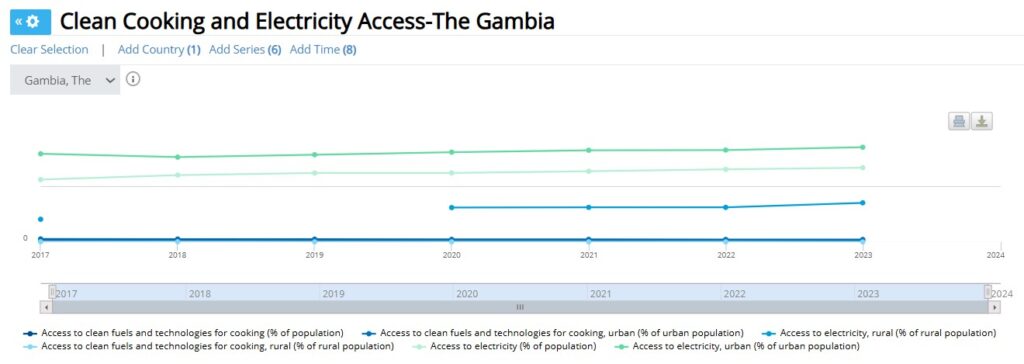
According to World Bank data, 1.6% of the population had access to clean fuels and technologies for cooking in 2023, a 0.1% decline from 2022. In 2023, 2.3% of the urban population had access to clean cooking fuels, compared with just 0.1% of the rural population.
Compared with access to clean cooking fuels and technologies, there is better access to electricity in The Gambia: 66.9% of the population had access in 2023, high from 65.4% in 2022.
The disparity between urban and rural areas is stark, highlighting a severe rural energy poverty gap, with rural communities almost entirely dependent on traditional biomass like firewood and charcoal.
Click ‘Read more’ to explore relevant aspects of Gambia’s Nationally Determined Contribution and other policies relevant to clean cooking.
Nationally Determined Contributions
The Gambia’s Nationally Determined Contributions (NDC) under the Paris Agreement acknowledge the importance of clean cooking within the broader context of climate mitigation and energy transition. While clean cooking is not explicitly detailed with standalone targets, it is indirectly integrated through several thematic areas. First, the NDC emphasizes the promotion of renewable energy and energy efficiency, aiming to increase the renewable energy share to 55% by 2030 and to double energy efficiency gains. This directly supports the adoption of clean and energy-efficient cooking technologies such as improved biomass stoves, electric cooking appliances, and solar cookers.
In addition, the NDC addresses household bioenergy consumption and its contribution to deforestation. Woodfuel use—primarily firewood and charcoal for cooking—is identified as a major driver of forest degradation. Therefore, promoting clean cooking solutions is essential for achieving the country’s forest conservation target of maintaining at least 30% forest cover. The NDC also highlights opportunities in waste-to-energy, particularly the generation of biogas from organic waste and wastewater, which aligns with promoting biogas digesters for clean cooking at household and institutional levels.
Furthermore, The Gambia’s NDC Implementation Plan (2021–2030) prioritizes the energy sector and outlines integrated actions across energy, waste, and agriculture. Although it does not include specific quantitative targets for clean cooking, it offers a framework through which such interventions can be monitored and scaled. Institutional efforts led by the Ministry of Environment, Climate Change, and Natural Resources support these strategies, aiming to coordinate and track progress in climate mitigation, including cleaner energy solutions for households.
Overall, clean cooking remains a critical, though underemphasized, component of The Gambia’s climate agenda. Strengthening its visibility within the NDC framework—by including specific targets for cookstove adoption or alternative fuel deployment—could enhance access to climate finance and improve health, gender equality, and environmental outcomes in line with the country’s sustainable development goals.
| Source | The Gambia NDCs-2021 |
The Gambia has 2 registered cookstove projects. These projects have generated 0.16 million carbon credits to date.
Click ‘Read more’ to explore the dashboard.
- Total Credits Issued: 167,575
- Total Credits Retired: 0
- Number of Projects: 2 (0 GS+ 2 VCS)
- Count of Project Developers: 2
Source: Voluntary Registry Offsets Database (Berkeley Carbon Trading Project)
| Name | Lead | Status | Dates | Applicable Fuels | Fund size for clean cooking | Total fund size | Comments |
| West Africa Clean Cooking Fund | Clean Cooking Alliance | Active | 2022-Present | LPG | $1 million | $1 million | This is a regional initiative, with The Gambia included |
| Clean Cooking for Africa (OPEC Fund/GLPGO) | OPEC Fund+Global LPG Partnership | Completed | 2017 (Pilot) | LPG | Not Specified | $1.5 million (est.) | This is a regional initiative, with The Gambia included |
Connect With Us
If you’d like to see more data on this page, please email carbon@cleancooking.org or fill in the form below.
