
What does fuel stacking tell us about clean cooking customers?
The challenge of clean cooking often centers on access: simply put, 2 billion people don’t have it, and therefore must rely on polluting fires and inefficient stoves to cook. A separate but related issue is why many people who do have access to clean cooking solutions still choose to use polluting fuels. To find out, CCA’s User Insights Lab conducted the largest study to date of fuel stacking in sub-Saharan Africa.
[Join the webinar on 30 June 2026 to hear the study’s authors discuss the results.]
Why fuel stacking matters
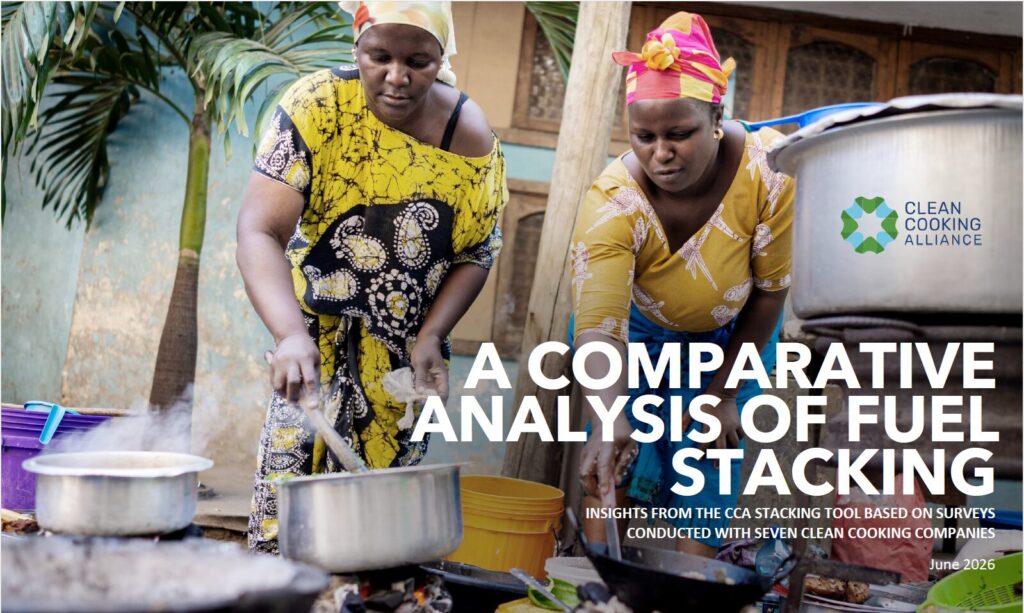
“Fuel stacking” is the practice of cooking with multiple stoves and fuels in parallel. For example, a household might alternately (or simultaneously) cook with modern options like an electric pressure cooker and a gas stove but also use a smoky charcoal stove.
For home cooks, this practice matters because polluting fuels can contribute to household air pollution and associated health problems. And it means that families are likely not benefiting fully from the advantages of clean cooking—not just the cleaner air, but also lower energy costs, time savings, and lower environmental degradation.
For clean cooking companies, fuel stacking is a business problem, undercutting potential revenues from fuel sales or from carbon credits.
Moreover, the practice of fuel stacking is extremely common, pointing to widespread gaps where clean cooking solutions are not entirely meeting consumers’ needs.
How the study was conducted
To better understand the motivations behind fuel stacking, CCA used its customizable Fuel Stacking Toolkit to carry out more than 3,000 surveys among customers of clean cooking companies. These companies were:
- Bboxx (pay-as-you-go LPG stoves, Kenya)
- BURN (electric induction stoves, Kenya)
- CarbonSink (improved charcoal stoves, Mozambique)
- KOKO Networks (ethanol stoves, Kenya)
- MGas (pay-as-you-go LPG stoves, Kenya)
- SupaMoto (pellet stoves, Zambia)
- Zipolopolo (pellet stoves, Malawi)
What the study revealed
Fuel stacking is prevalent. Most customers used their “target cooking technology” (i.e., the one supplied by one of the clean companies listed above) for about half of their cooking needs, relying on 2-3 different fuels overall. For each given company, the majority of their customers relied on a similar combination of fuels. For example, users of BURN’s induction stove tended to also cook heavily with LPG and, to a lesser extend charcoal; for users of Bboxx’s LPG stove, charcoal use was common, and some customers also used firewood.
Affordability is a key concern. The availability of lower-cost options influenced people’s cooking decisions. Moreover, there was a common perception that foods that require a long time to cook are simply too expensive with clean fuels.
Fuel availability impacts the use of a clean stove. At the time of the survey, SupaMoto was experiencing manufacturing bottlenecks with their pellet production, leading to fuel shortages. This was reflected in how much customers used their stove. Similarly, power cuts in rainy seasons affected any device that required electricity, including induction stoves, pellet gasifier stoves, and pay-as-you-go LPG stoves.
Stoves with single burners are a limitation. Where clean stoves only have a single burner, many cooks chose to simultaneously use another fuel and appliance in order to prepare several dishes at once. A two-burner option appears to largely resolve this issue: owners of MGas’ double-burner LPG stove used it for 80% of their cooking needs, compared to around 50% for other clean stoves. Consumers also reported a limitation specific to induction stoves, which was an insufficient number of compatible cooking pots.
Clean stoves are seen as incompatible with certain foods. Consumers often chose to use other fuels for grilling, roasting, long boiling, and baking. Certain dishes were more likely to drive stacking. For instance, making ugali—a maize-based dish that requires heavy pounding and mixing—was seen as incompatible with the slippery surface of an induction stove. And many users of CarbonSink’s improved charcoal stove preferred to grill meat over an open fire rather than risk getting water or grease on their more modern stove.
Nairobi is undergoing a particularly rapid transition to clean cooking. Consumers there are increasingly using multiple types of clean stoves and fuels at once.
[Learn more about the work of CCA’s User Insights Lab.]
Interpreting the findings to improve clean cooking solutions
The survey’s extensive findings have numerous, context-specific implications for how clean cooking companies can better serve customers. The report’s recommendations include:
- To address technical limitations: Offer double-burner stoves or a second single-burner appliance that performs well for different cooking processes (e.g., pairing an induction cooker with an electric pressure cooker). For induction stoves, offer cooking pots in a range of sizes. For gasifier stoves and pay-as-you-go LPG stoves, ensure there is a back-up electricity source such as a power bank.
- To address affordability concerns: Develop user interfaces and appliance designs that allow users to better track and understand their energy use. Invest heavily in training customers on correct stove usage, especially for appliances that involve regulating a flame.
- To address fuel availability: Invest in a consistent and accessible fuel supply chain or target customers in areas where these reliable supply chains already exist. Recognize that fluctuating availability and prices of fuels in certain seasons can present opportunities for customer acquisition and fuel promotions.
- For Kenya-based companies: Given Nairobi’s increasingly saturated market, consider focusing on expanding into new markets in other Kenyan cities.
To hear directly from the study’s authors and some of the clean cooking companies that participated in the research, register to join the webinar on Tuesday 30 June 2026.
To read the full study report, click here.